

Sodankylä Geophysical Observatory might seem like a bunch of humble buildings in the middle of nowhere. Yet, there a team of top scientists works to unravel the mysteries of the Northern Lights. The director, space physicist Eija Tanskanen, has good news for aurora spotters: the active years have just started.
The lane leading to a wooden building is lined with pine trees. A traditional, unpainted fence forms a square beyond the trees. Unlike in many places around here, the fence is not for keeping the reindeer out, but for catching something that can’t always be seen with human eyes.
The appearance of the buildings is also misleading. More than 40 people, scientists and engineers from all around the world work here at Sodankylä Geophysical Observatory (SGO). Together they want to understand something that humans can only observe in the dark polar sky: the Northern Lights.
Eija Tanskanen, the director of the SGO, has studied the Northern Lights and magnetic disturbances in the atmosphere for more than 30 years.
As a child, she would lie down in the snow and wonder what the Northern Lights actually were. Before settling in Sodankylä, Tanskanen worked in various research, teaching and management positions, including at NASA’s Goddard Space Flight Center.
Science has progressed a lot since Tanskanen’s early years, benefiting all of us. Giant leaps in navigation technologies – in compasses and airplanes – are due to increased knowledge of magnetic fields and disturbances.
“We understand the atmosphere much better now,” Tanskanen says.
Understanding the Northern Lights is closely related to understanding magnetic fields. The Northern Lights occur approximately 100 kilometres (60 miles) from the ground, in the upper atmosphere, when the sun’s solar wind carries magnetic storms towards the earth. The lights follow the earth’s magnetic fields. In northern regions it’s called aurora borealis, and in southern regions, aurora australis.
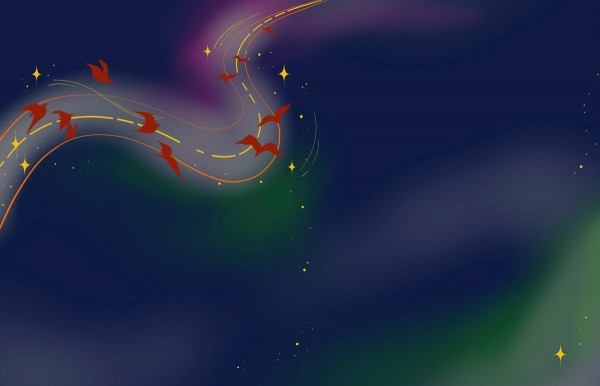
What do birds see?

Illustration: Annu Kilpeläinen
Outside the observatory Tanskanen walks along the sandy road. She keeps gazing up so she can see the sky. That has been her constant position since her early years: eyes toward space.
For her PhD, Tanskanen studied the sun’s energy budget, or, as she frames it more practically, “where the Northern Lights get their energy from.”
Located 120 kilometres (75 miles) north of the Arctic Circle in Finnish Lapland, the Sodankylä observatory has served as a base for scientific geophysical measurements since 1914.
Today, the observatory is an independent research department of the University of Oulu. From the very beginning, the earth’s magnetic fields have been measured here.
“All things that are related to navigating or going in some direction, such as planes and compasses, are based on measuring the magnetic fields,” Tanskanen says.
The magnetic poles are places where the magnetic fields are vertical. The earth has two magnetic poles: in the north and south. The Northern Lights are only visible for the human eye around magnetic pole areas when a solar storm hits the planet. Migratory birds use magnetic fields for navigation. They can see the magnetic fields like humans can see roads.
Polar expeditions ahead

Sodankylä provides the perfect conditions for studying the Northern Lights, says Eija Tanskanen.Photo: Sabrina Bqain
The geophysical science community has a problem. The locations of the magnetic poles are in constant movement, and their exact geographical points are currently unknown. They are not the same as the geographical poles, and at the moment they should be about 500 kilometres (300 miles) from each other.
Insufficient knowledge of the magnetic poles’ location causes inaccuracy in navigation, especially in polar areas.
“We know that the magnetic north pole left Canada’s archipelago at the end of last century and that it is moving somewhere in the Arctic Ocean towards Siberia,” Tanskanen says.
The solution for the problem is to go and find the wandering magnetic poles. In September 2025, a polar expedition starts its journey from Sodankylä to an unknown spot somewhere in the middle of the Arctic Ocean to find the earth’s magnetic north pole. A similar trip to the south starts in February 2026.
“The explorers don’t know where the pole is, nor what the conditions will be,” says Tanskanen.
The explorers might need to ski or even swim to reach the pole. To add to the challenge, reaching the exact location of the pole is not enough. The explorers must somehow let the rest of the world know the location, from the edge of the world.
“We don’t know yet how it will be done,” Tanskanen says.
What is certain, though, is that the most important equipment for these expeditions will be made here in Sodankylä. It includes a special, ball-shaped compass that will point downward at the exact location of the magnetic pole.
Connected to the universe
Source: finland.fi
